
Comparing Siemens Hearing Aids: Features Explained
When navigating the world of audiology, finding the right device can feel like a daunting task. The sheer volume of technological advancements, styles, and brands can easily overwhelm anyone trying to improve their hearing health. However, one name has consistently stood out for over a century, offering pioneering solutions that blend medical-grade audiology with consumer-friendly design. If you are looking into Comparing Siemens Hearing Aids: Features Explained, you are in the right place.
Before we dive deeply into the specific devices, it is crucial to understand the evolution of the brand. While many people still search for and refer to siemens hearing aids, the medical technology giant’s hearing aid division was acquired and rebranded as Signia (now part of WS Audiology). Today, Signia carries the torch of the Siemens legacy, building upon decades of acoustic engineering to deliver some of the most advanced hearing solutions in the world.
In this comprehensive guide, we will break down the latest platforms, compare popular models, explore groundbreaking audiological features, and provide practical advice on connectivity, pricing, and troubleshooting. Whether you are a first-time wearer or looking to upgrade your current devices, this guide will help you make an informed decision.

Better hearing better life consultation
The Evolution: From Siemens to Signia
Understanding the transition from Siemens to Signia is vital for anyone researching these devices. Siemens began its journey in hearing technology in the late 19th century when Werner von Siemens invented the Phonophor, a device designed to help those with hearing loss. Over the decades, Siemens became synonymous with reliability, durability, and innovation in audiology.
In 2015, Siemens sold its hearing aid business, which subsequently rebranded as Signia. Today, when we discuss siemens hearing aids features, we are actually looking at the cutting-edge technology developed under the Signia brand name. The brand has maintained the rigorous engineering standards of its predecessor while accelerating digital innovation, sleek design, and artificial intelligence integration.
Core Technological Platforms: The Brains Behind the Hearing Aids
To truly understand what makes these devices special, we must look at the computer chips and algorithms powering them. Signia’s recent platforms have redefined how hearing aids process sound. Two of the most prominent platforms on the market today are the Augmented Xperience (AX) and the Integrated Xperience (IX).
Signia Integrated Xperience vs Augmented Xperience
The processing platform is the engine of your hearing aid. When comparing the Signia Integrated Xperience vs Augmented Xperience, we are looking at an evolution from exceptional dual-processing to unprecedented multi-speaker tracking.
Augmented Xperience (AX): Introduced as a revolutionary step in audiology, the AX platform uses two separate acoustic processors. Traditional hearing aids process all sounds—speech, background noise, music—through a single track, which often results in a flattened soundscape. The AX platform changed this by splitting the audio. One processor is dedicated entirely to focus sounds (like the person talking in front of you), while the other manages ambient background sounds.
- The Result: Speech sounds crisp and clear, while background noise is kept at a comfortable, natural level without overwhelming the listener.
Integrated Xperience (IX): The IX platform is Signia’s latest and most advanced technology. While AX revolutionized one-on-one conversations, IX is built for dynamic, group conversations. It features a RealTime Conversation Enhancement architecture that tracks multiple moving speakers simultaneously.
- The Result: If you are at a dinner party and people are talking from your left, right, and across the table, the IX platform instantly identifies where the speech is coming from and enhances those voices independently of the background noise. It adapts 1,000 times a second to ensure you never miss a punchline or a critical piece of information.
Speech Clarity Technology in Signia Hearing Aids
The primary goal of any hearing device is to make speech understandable. The speech clarity technology in Signia hearing aids relies on a combination of directional microphones, ultra-fast sound sampling, and artificial intelligence.
By utilizing dynamic beamforming, the hearing aids can create a narrow “beam” of focus directed precisely at the person speaking to you. Furthermore, Signia’s advanced algorithms map the acoustic environment, determining the signal-to-noise ratio and instantly applying noise reduction algorithms to non-speech frequencies. This ensures that consonants—which are critical for understanding speech but are often the first frequencies lost to hearing impairment—are crisp and audible.

Signia Integrated Xperience product showcase
Comparing Form Factors: Finding Your Perfect Fit
Hearing aids are not one-size-fits-all. They come in various shapes and sizes to accommodate different degrees of hearing loss, anatomical differences in ear canals, and personal style preferences.
Difference Between RIC and BTE Signia Models
When browsing models, you will frequently see the acronyms RIC and BTE. Understanding the difference between RIC and BTE Signia models is the first step in narrowing down your options.
RIC (Receiver-in-Canal):
- Design: The main body of the hearing aid sits behind the ear, but the speaker (receiver) is removed from the casing and placed directly into the ear canal, connected by an ultra-thin, nearly invisible wire.
- Pros: They are incredibly discreet, lightweight, and produce a very natural sound because the speaker is closer to the eardrum. They also leave the ear canal partially open, preventing the “plugged up” feeling (occlusion effect).
- Best For: Mild to severe hearing loss. RICs are currently the most popular style on the market.
BTE (Behind-the-Ear):
- Design: All electronic components, including the speaker, are housed in the casing behind the ear. The sound is directed into the ear canal via a clear plastic tube connected to a custom-molded earpiece.
- Pros: BTEs are typically larger, making them easier to handle for individuals with dexterity issues. Because the delicate speaker is kept out of the moist environment of the ear canal, they are often more durable and less prone to wax damage. They can also house larger batteries and more powerful amplifiers.
- Best For: Moderate to profound hearing loss.
Custom In-Ear Models
For those who prefer nothing behind their ear, Signia offers models that sit entirely inside the ear. These range from devices that fill the entire outer ear bowl (ITE) to those that sit deep and invisibly within the canal (CIC).
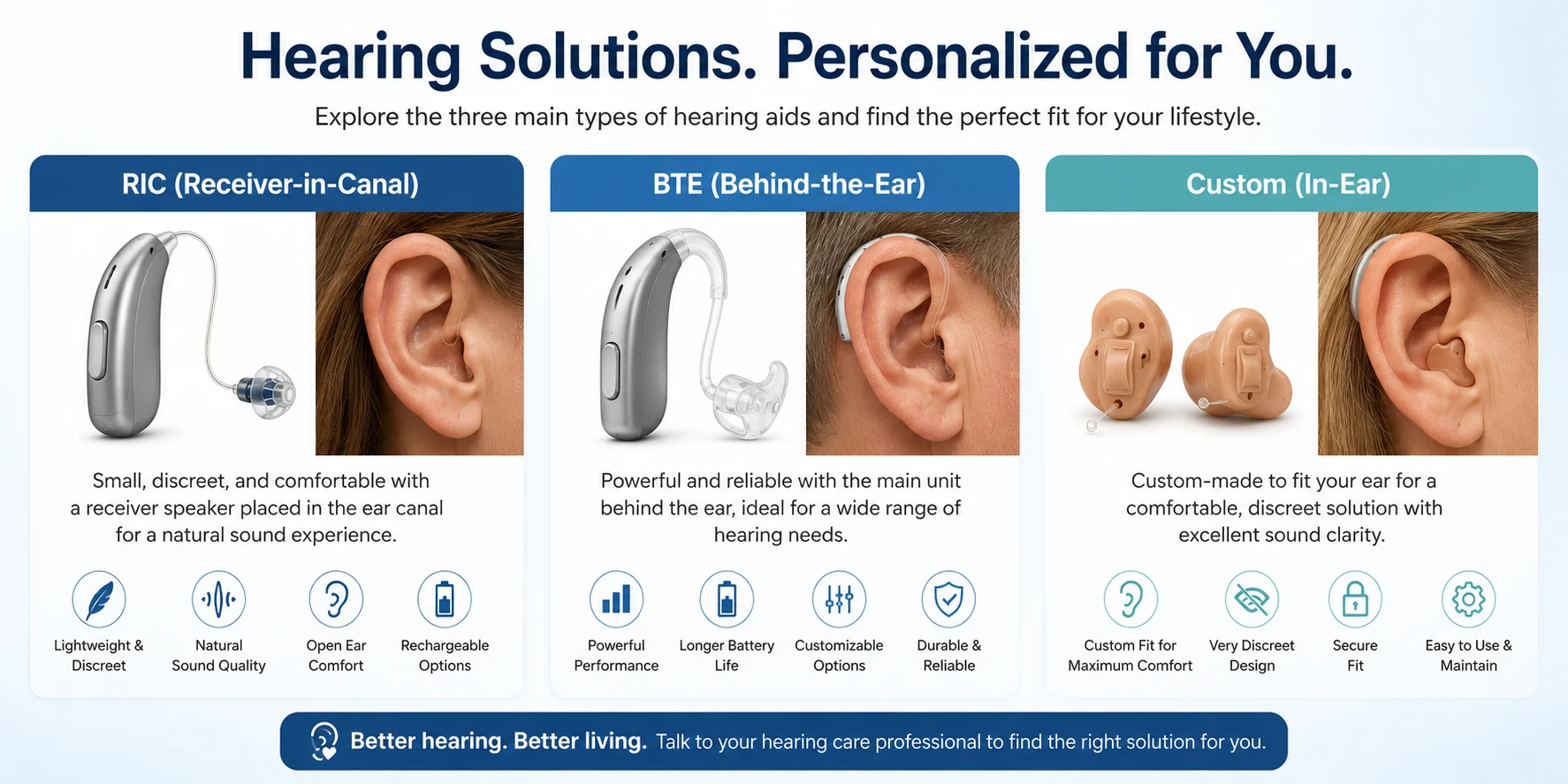
Hearing aid solutions for every need
Detailed Model Comparisons
Now that we understand the platforms and styles, let’s dive into the specific models. Signia’s portfolio is vast, catering to different lifestyles, aesthetic preferences, and audiological needs.
Signia Styletto vs Pure Charge&Go Models
One of the most common comparisons consumers make is between the Signia Styletto vs Pure Charge&Go models. Both are exceptional RIC devices, but they serve slightly different priorities.
Signia Styletto: The Styletto was designed to shatter the stigma associated with hearing aids. It does not look like a medical device; instead, it resembles a piece of high-end wearable technology.
- Design: It features an ultra-slim, elongated form factor made possible by a custom-shaped pin lithium-ion battery. It sits very flat against the head, making it virtually unnoticeable, especially for people who wear glasses.
- Charging: It comes with a pocket-sized portable charging case that provides multiple charges on the go, much like premium wireless earbuds.
- Target Audience: The fashion-conscious user who wants a sleek, stylish device without compromising on the latest IX or AX technology.
Signia Pure Charge&Go: The Pure Charge&Go is Signia’s flagship workhorse. It adopts a more traditional, slightly teardrop-shaped RIC design.
- Design: While slightly thicker than the Styletto, it is still highly discreet. The slightly larger body allows it to house different components.
- Battery and Power: The Pure typically offers slightly longer battery life on a single charge compared to the Styletto and comes with options for a T-coil (telecoil) model, which can connect directly to loop systems in public venues like theaters and churches.
- Target Audience: The pragmatic user who prioritizes maximum battery life, telecoil functionality, and traditional aesthetic discretion.
Signia Active Pro vs Traditional Hearing Aids
The line between consumer electronics and medical devices is blurring, and nowhere is this more evident than when comparing Signia Active Pro vs traditional hearing aids.
The Signia Active Pro features an earbud design that looks almost identical to mainstream wireless consumer earbuds (like Apple AirPods Pro or Samsung Galaxy Buds). However, inside, it contains prescription-grade audiological technology.
- The Appeal: Many individuals are hesitant to wear traditional hearing aids due to perceived stigma. Because society is now completely accustomed to seeing people wearing wireless earbuds all day, the Active Pro offers a socially camouflaged solution.
- The Fit: Unlike traditional custom hearing aids that require a deep ear impression, the Active Pro is “ready-to-wear.” It uses soft, interchangeable silicone sleeves to secure an instant, comfortable fit in almost any ear.
- The Performance: Despite its consumer-tech look, it features advanced noise reduction, Bluetooth streaming, and Signia’s high-end sound processing, making it a true medical device, unlike over-the-counter amplifiers.
Benefits of Signia Silk Rechargeable Invisible Hearing Aids
For the ultimate in discretion, the Silk line is unparalleled. Exploring the benefits of Signia Silk rechargeable invisible hearing aids reveals why it is a favorite for those wanting a hidden solution.
- Completely-in-Canal (CIC): The Silk is so small it sits completely inside the ear canal, making it essentially invisible from the outside.
- Instant Fit: Typically, CIC hearing aids require a custom mold of your ear, meaning a waiting period of weeks. The Silk utilizes incredibly soft, highly flexible silicone Click Sleeves. This means you can walk into a clinic, have the devices programmed, and walk out wearing them the exact same day.
- Rechargeability: Historically, CIC hearing aids relied on tiny disposable batteries that were difficult to change and died quickly. Signia recently introduced a rechargeable version of the Silk, allowing users to charge these tiny devices in a sleek, portable case.
Signia Insio Charge&Go AX Custom Fit Features
If you want an in-ear device but prefer one uniquely tailored to the exact contours of your ear anatomy, the Insio is the ideal choice.
The Signia Insio Charge&Go AX custom fit features include:
- Biometric Precision: Your audiologist will take a 3D scan or physical impression of your ear. The hearing aid is then 3D-printed to match the unique bends of your canal perfectly, ensuring maximum comfort and retention.
- Contactless Charging: It is the first custom hearing aid with contactless magnetic resonance charging. You simply drop the custom devices into the charger without worrying about aligning tiny charging contacts perfectly.
- Dual Processing: It houses the powerful AX platform, giving users the split-processing benefits for speech and noise in a custom shell.
Top Rated Signia Models for Severe Hearing Loss
Not all hearing aids have the physical capacity to push the volume required for severe to profound hearing loss. For these users, power is paramount.
The top rated Signia models for severe hearing loss include the Motion Charge&Go P (Power) and SP (Super Power) BTE models.
- Massive Amplification: These devices are built with robust receivers capable of delivering massive amounts of gain (volume) safely and clearly without feedback (whistling).
- Extended Battery Life: Because profound hearing loss requires significant processing power, these models feature large lithium-ion batteries capable of lasting up to 61 hours on a single charge.
- Durability: They feature a rugged design to withstand daily wear and tear, moisture, and dust.

Hear life beautifully with Styletto
Deep Dive into Unique Signia Features
Beyond the physical style of the hearing aids, what truly sets Signia apart are the proprietary software features running continuously in the background.
How Do Signia Own Voice Processing Features Work?
One of the most common complaints among new hearing aid users is the sound of their own voice. Because hearing aids amplify sound and occasionally block the ear canal, a wearer’s voice can sound loud, echoey, or like they are speaking inside a barrel. Signia solved this with OVP (Own Voice Processing).
So, how do Signia Own Voice Processing features work?
- Acoustic Scanning: During the fitting process, the audiologist has the wearer speak out loud. The hearing aids use their microphones to scan the wearer’s head and the unique acoustic path of their voice.
- Voice Recognition: The hearing aids learn to instantly recognize when the wearer is speaking versus when someone else is speaking.
- Independent Volume Control: When the wearer speaks, OVP instantly alters the processing, reducing the amplification of the wearer’s voice specifically, while continuing to amplify the surrounding environment and the person they are conversing with. This results in a natural-sounding own voice, vastly improving initial acceptance and comfort for new users.
Best Signia Hearing Aids for Background Noise
Navigating a loud restaurant or a busy family gathering can be exhausting for someone with hearing loss. Determining the best Signia hearing aids for background noise depends slightly on your preference for style, but any model utilizing the IX (Integrated Xperience) platform is currently the gold standard.
The IX models (like the Pure Charge&Go IX and Styletto IX) excel in background noise because of their RealTime Conversation Enhancement.
- Acoustic Sensors: They constantly scan the environment for noise sources (like clinking dishes, background chatter, or air conditioning).
- Spatial Awareness: They track the location of the people you are talking to.
- Dynamic Suppression: They actively suppress the noise sources while simultaneously boosting the targeted speech signals. This means you do not have to look directly at the person speaking to understand them, allowing for natural, fluid group conversations even in high-noise environments.
Understanding Signia Tinnitus Therapy Signals
Tinnitus (a ringing, buzzing, or hissing sound in the ears) affects millions of people and frequently accompanies hearing loss. Signia is a pioneer in integrating advanced tinnitus management into their devices.
Understanding Signia Tinnitus Therapy signals requires looking at the three distinct approaches they offer:
- Static Noise Therapy: The hearing aids generate a soft, continuous noise (like a gentle hum or white noise) that blends with the tinnitus, drawing the brain’s attention away from the ringing.
- Ocean Wave Therapy: For a more relaxing experience, the devices can generate soothing, fluctuating sounds that mimic ocean waves crashing on a beach. This is highly effective for reducing the stress and anxiety often associated with tinnitus.
- Notch Therapy: This is a world-first, proprietary feature. Unlike the other methods that introduce a new sound, Notch Therapy works silently in the background. The audiologist identifies the exact pitch of your tinnitus. The hearing aid then creates a “notch” (a reduction in amplification) at that specific frequency. Over time, this trains the brain to ignore the tinnitus sound entirely, offering a true long-term reduction in the perception of the ringing.

Notch therapy for tinnitus relief
Connectivity and the Digital Lifestyle
Modern hearing aids are essentially tiny, highly advanced Bluetooth earpieces. They connect to our digital lives, transforming how we interact with phones, televisions, and computers.
Connecting Signia Hearing Aids to iPhone and Android
Seamless streaming is a massive benefit. Whether it is a phone call with a loved one, a podcast, or GPS directions, hearing the audio directly in your ears with your specific prescription applied is game-changing.
Connecting Signia hearing aids to iPhone and Android has never been easier:
- For iPhone Users (MFi – Made for iPhone): Signia devices connect directly to Apple’s iOS. You pair them via the Settings > Accessibility > Hearing Devices menu. Once connected, phone calls and media stream directly to both ears with incredible clarity. You can also use the iPhone’s built-in controls to adjust volume and programs.
- For Android Users (ASHA – Audio Streaming for Hearing Aids): Signia devices utilize the ASHA protocol to stream directly from compatible Android devices. Pairing is done through the phone’s Bluetooth menu. Furthermore, newer Signia models feature Bluetooth LE Audio, the next generation of wireless audio that offers better sound quality and lower battery consumption.
Pro-Tip: If you want true hands-free calling (where the hearing aid microphones pick up your voice so you don’t have to hold the phone to your mouth), ensure you are looking at the latest AX or IX models, which support this feature for iOS devices, and increasingly for newer Androids.
Signia Hearing Aid App Features and Compatibility
To get the most out of your devices, the smartphone app is essential. Exploring the Signia hearing aid app features and compatibility reveals a suite of tools that put control directly in the user’s hands.
- Remote Control: Adjust volume, change listening programs (e.g., from “Normal” to “Live Music”), and adjust the directional focus of the microphones.
- Signia Assistant: This is a highly advanced, AI-powered feature. If you are struggling to hear in a specific environment, you open the app and chat with the Assistant. You might say, “The background noise is too harsh.” The AI will instantly analyze your acoustic environment and propose a tailored setting adjustment. If you like the new sound, you keep it. It is like having an audiologist in your pocket.
- TeleCare: This allows your audiologist to adjust your hearing aids remotely. If you move or simply cannot make it into the clinic, you can request an adjustment via the app. The audiologist sends a new settings file over the internet, and you apply it to your hearing aids instantly.
- Face Mask Mode: Initially developed during the pandemic, this button instantly adjusts frequencies to make muffled speech (like speech coming through a mask or a thick scarf) clearer.
Troubleshooting Signia Hearing Aid Bluetooth Connectivity Issues
Even the most advanced technology can experience hiccups. If you encounter problems, troubleshooting Signia hearing aid Bluetooth connectivity issues is usually straightforward. Here is a step-by-step guide:
- Check the Basics: Ensure your hearing aids are fully charged and your phone’s Bluetooth is turned on.
- Toggle Bluetooth: Turn your phone’s Bluetooth off, wait 10 seconds, and turn it back on.
- Restart the Hearing Aids: For rechargeable models, place them in the charger for 10 seconds and take them out. For battery models, open and close the battery door. This puts them in “pairing mode” for 3 minutes.
- Forget and Re-pair: Go to your phone’s Bluetooth or Accessibility settings. Find the hearing aids, select “Forget this device,” and go through the initial pairing process again.
- Update the App/OS: Ensure both the Signia app and your phone’s operating system are fully up to date. Outdated software is a primary culprit for dropped connections.
- Clear App Cache: On Android devices, going into settings and clearing the Signia app’s cache can resolve syncing glitches.
The Financial Aspect: Pricing and Value
Hearing aids are a significant investment in your health, cognitive function, and quality of life. Understanding the costs associated with these devices helps manage expectations and budgets.
Signia Hearing Aid Price Comparison Guide
Because hearing aids are typically sold through licensed audiologists and hearing instrument specialists, prices often include the cost of professional services (testing, fitting, programming, and follow-up care). Therefore, a precise Signia hearing aid price comparison guide must account for variations in clinic pricing models.
Generally, Signia hearing aids are categorized into technology tiers, usually denoted by numbers: 3 (Standard), 5 (Advanced), and 7 (Premium).
- Tier 3 (Standard): Excellent for quieter lifestyles, one-on-one conversations, and television viewing.
- Estimated Price Range: 1,29,999 to 2,50,000 2 Unit.
- Tier 5 (Advanced): Great for moderate activity levels, smaller group settings, and occasional noisy environments. Offers better background noise suppression.
- Estimated Price Range: 3,69,999 to 4,00,000 2 Unit.
- Tier 7 (Premium): Features the full, unbridled power of the IX or AX platform. Best for highly active individuals who frequent noisy restaurants, meetings, auditoriums, and complex listening environments.
- Estimated Price Range: 5,00,000 to 7,00,00+ 2 Unit.
Note: When looking at prices, always ask your hearing care professional whether the price is “bundled” (includes all future appointments for 1-3 years) or “unbundled” (you pay a lower upfront cost for the devices but pay a-la-carte for future office visits).
How to Navigate Hearing Aid Reviews
When researching, you will undoubtedly encounter numerous hearing aid reviews online. While helpful, it is important to read them with a critical eye.
- Acoustic Subjectivity: Hearing loss is highly individual. A device that sounds “tinny” to one person might sound perfectly clear to someone with a different type of hearing loss. Focus on reviews discussing battery life, app reliability, and physical comfort.
- Professional Fitting Matters: Often, a negative review is not a reflection of a bad hearing aid, but rather a poor fitting by the provider. The most expensive hearing aid in the world will sound terrible if it is not programmed correctly to the user’s specific audiogram.
- Look for Consistency: Look for trends in reviews. If 50 people praise the Styletto’s charging case, it is likely a great feature. If multiple people report Bluetooth dropping on a specific Android phone model, take note of that compatibility issue.
Actionable Tips for New Signia Users
If you decide to move forward with Signia devices, the first few weeks are a critical adjustment period. Here are actionable tips to ensure success:
- Wear Them Consistently: Your brain needs time to adapt to hearing sounds it has been missing for years. Wear your devices from the time you wake up until you go to sleep, even if you are just sitting quietly at home. The rustle of a newspaper or the hum of the refrigerator are sounds your brain needs to relearn to process.
- Start Slow in Noise: Don’t make your first outing a crowded, noisy pub. Start by having conversations in quiet rooms, then gradually introduce background noise like a television. Work your way up to complex environments.
- Practice Maintenance: Wipe down your hearing aids every night with a dry microfiber cloth. If you have RIC or Custom models, regularly change the tiny white wax guards on the tips. Earwax is the number one cause of hearing aid malfunction.
- Utilize Your Audiologist: Do not be afraid to return for adjustments. The initial fit is just a starting point. Keep a journal of sounds that are too loud, too soft, or annoying, and share this with your provider so they can fine-tune the programming.
Conclusion
The journey to better hearing is highly personal, but choosing the right technology provides a monumental head start. Through our comprehensive look at Comparing Siemens Hearing Aids: Features Explained, it is clear that Signia has successfully carried the historic Siemens legacy into the modern digital age.
From the multi-speaker tracking of the Integrated Xperience platform to the stigma-breaking design of the Active Pro earbuds, Signia offers a diverse portfolio tailored to individual needs. Whether you prioritize the invisible nature of the Silk CIC, the battery power of the Pure Charge&Go, or the sleekness of the Styletto, the key to success lies in partnering with a skilled audiologist. By pairing cutting-edge siemens hearing aids features with professional fitting and persistent daily wear, you can confidently reclaim the sounds of your life, stay connected with loved ones, and thrive in any acoustic environment.


Leave a Comment
Your email address will not be published. Required fields are marked *