
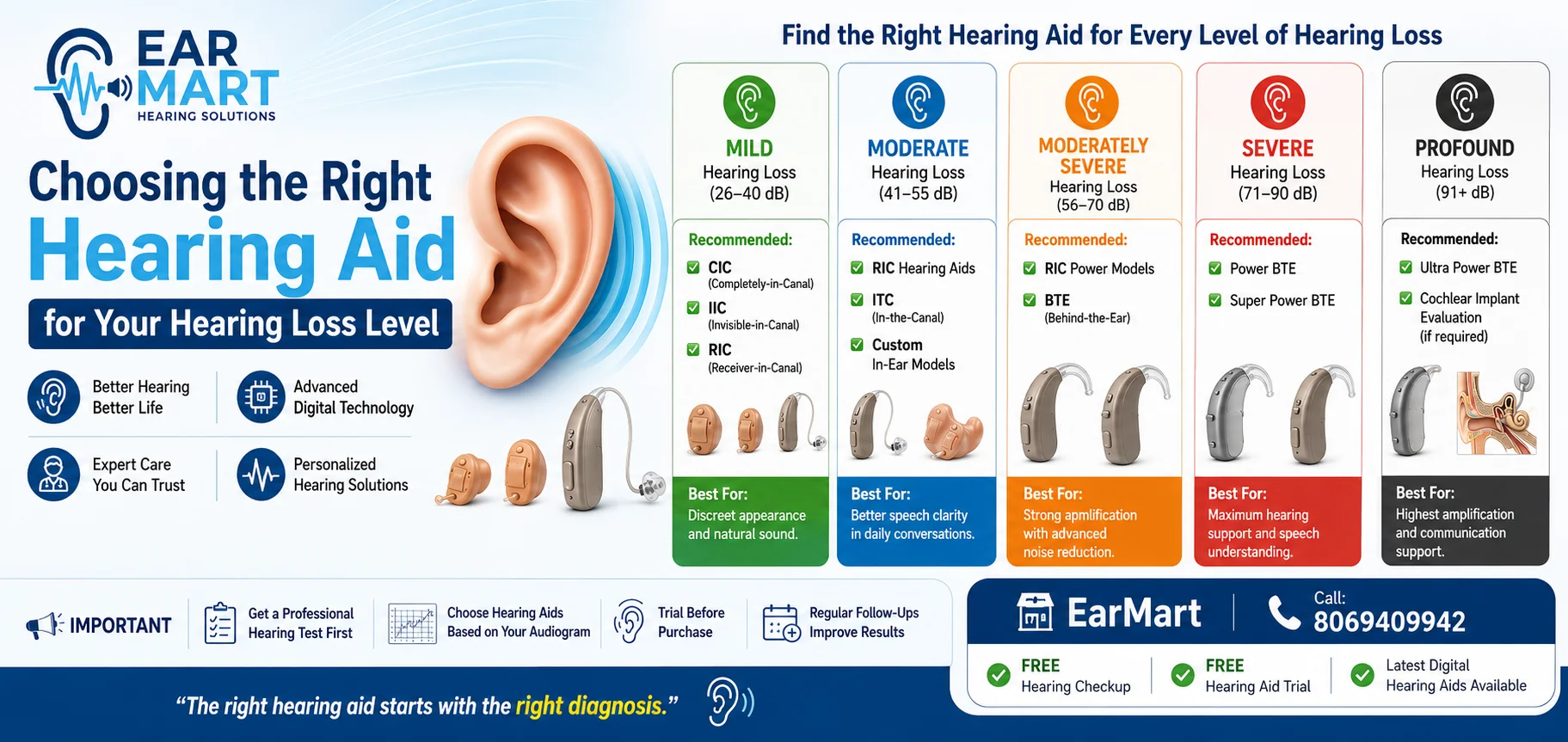
Choosing the right hearing aid guide
Understanding Hearing Loss: Types and Levels
Hearing loss affects millions of people worldwide and exists on a broad spectrum. It is generally categorized into four degrees: mild (26–40 dB), moderate (41–55 dB), moderately severe (56–70 dB), severe (71–90 dB), and profound (91+ dB). Understanding where you fall on this spectrum is the essential first step toward finding an effective solution.
Hearing loss can also be classified by type. Sensorineural hearing loss involves damage to the inner ear or auditory nerve and is the most common form. Conductive hearing loss stems from problems in the outer or middle ear, often treatable medically. Mixed hearing loss combines both types, requiring a more tailored approach.
The Importance of Choosing the Right Hearing Aid
Not all hearing aids are created equal — and choosing the wrong one can mean wasted investment and continued frustration. The right hearing aid amplifies the specific frequencies you struggle with, fits comfortably in your lifestyle, and matches the severity of your hearing loss.
An ill-fitted device can lead to over-amplification, discomfort, or simply not addressing the root problem. Conversely, a well-matched hearing aid can dramatically improve communication, reduce listening fatigue, and enhance your overall quality of life.
Key Features to Consider in Hearing Aids
When evaluating hearing aids, several features stand out as particularly impactful:
- Directional microphones — help focus on the sounds you want to hear while reducing background noise.
- Noise reduction — filters out environmental sounds for clearer speech understanding.
- Bluetooth connectivity — enables wireless streaming from phones, TVs, and other devices.
- Rechargeable batteries — offer convenience and sustainability over disposable options.
- Telecoils — improve hearing in public spaces equipped with hearing loop systems.
- App-based controls — allow discreet, real-time adjustment of settings via smartphone.
Prioritize features based on your daily environment and communication needs, not just technical specifications.
How to Assess Your Hearing Loss Level
A proper hearing assessment begins with a professional audiological evaluation, which includes pure-tone audiometry (testing how softly you can hear tones at different pitches) and speech discrimination tests (evaluating how well you understand words). The results are plotted on an audiogram, which serves as a roadmap for selecting the right device.
Online hearing tests can offer a preliminary indication, but they are no substitute for a clinical evaluation. If you notice consistent difficulty understanding speech, frequently ask people to repeat themselves, or turn up the TV louder than others prefer, schedule a full hearing assessment without delay.
Different Types of Hearing Aids Explained
Hearing aids come in several form factors, each suited to different levels of hearing loss and lifestyle preferences:
- Behind-the-ear (BTE) — sits behind the ear with a tube connecting to an ear mold. Suitable for mild to profound loss and easy to handle.
- Receiver-in-canal (RIC/RITE) — similar to BTE but with a thin wire and a small receiver placed in the ear canal. Popular for mild to severe loss.
- In-the-ear (ITE) — custom-molded to fit in the outer ear bowl. Good for mild to severe loss with easier volume control.
- In-the-canal (ITC) — smaller and more discreet than ITE, fits partly in the canal. For mild to moderate loss.
- Completely-in-canal (CIC) — nearly invisible, fitting deep in the ear canal. Best for mild to moderate loss.
- Invisible-in-canal (IIC) — the most discreet option, sitting deepest in the canal. Limited to mild to moderate loss.
The right type depends on your degree of hearing loss, dexterity, cosmetic preferences, and lifestyle.
Comparing Hearing Aid Brands and Models
The hearing aid market is led by several reputable manufacturers, each offering distinct strengths. Phonak is known for its wireless connectivity and rechargeable options. Oticon focuses on brain-centered hearing through its open sound experience technology. Signia (formerly Siemens) is recognized for natural sound quality and its own-voice processing features. ReSound offers excellent Bluetooth streaming with iOS and Android compatibility. Widex is praised for its pure, natural sound signature.
When comparing models, look beyond marketing claims. Prioritize devices that have been tested and recommended by your audiologist based on your specific audiogram and lifestyle profile. Trial periods are standard in reputable clinics — use them.
The Role of Audiologists in Selecting Hearing Aids
An audiologist is your most valuable ally in the hearing aid selection process. Beyond performing the hearing evaluation, they interpret your audiogram, recommend appropriate device categories, perform custom fittings, and program the hearing aid to your specific hearing profile.
Professional fitting involves real-ear measurement (REM), a clinical technique that verifies the hearing aid is actually delivering the prescribed amplification in your ear canal — not just at a simulated average. Follow-up visits for fine-tuning are equally important as your brain adapts to amplified sound over weeks and months.
Hearing Aid Technology: Innovations and Advancements
Modern hearing aids have evolved far beyond simple sound amplifiers. Today’s devices incorporate artificial intelligence to automatically adjust settings based on your acoustic environment, whether you are in a quiet office, a noisy restaurant, or outdoors. Machine learning algorithms now enable hearing aids to learn your preferences over time.
Other notable advancements include fall detection and health monitoring features, direct audio streaming from virtually any Bluetooth-enabled device, extended battery life through lithium-ion rechargeables, and over-the-air firmware updates that can improve performance without a clinic visit. Rechargeable hearing aids with fast-charging capabilities now offer a full day of use from a short charging session.
Cost Considerations and Insurance Coverage for Hearing Aids
Hearing aids represent a significant investment, with quality devices typically ranging from moderate to premium price tiers. Premium models with advanced AI features, rechargeable batteries, and extended warranties command higher prices, while entry-level devices remain effective for straightforward hearing loss profiles.
Insurance coverage varies widely. Some employer health plans and Medicare Advantage plans offer partial or full coverage for hearing aids. Many audiologists offer financing plans, and some manufacturers provide direct-to-consumer options at reduced cost. Veterans and eligible individuals may access hearing aids through government programs. Always clarify what is covered before committing to a purchase, and factor in the cost of follow-up appointments and batteries or charging accessories over the device’s lifespan.
Conclusion: Making an Informed Decision for Better Hearing
Selecting the right hearing aid is not a one-size-fits-all decision. It requires understanding your type and degree of hearing loss, evaluating device features against your daily needs, partnering with a qualified audiologist, and staying informed about technological advancements.
Invest time in the selection process — trial periods, professional fittings, and honest assessments of your lifestyle demands will guide you toward a device that genuinely transforms your hearing experience. Better hearing is not just about amplifying sound; it is about reconnecting with the conversations, environments, and moments that matter most to you.


Leave a Comment
Your email address will not be published. Required fields are marked *