
Understanding hearing loss types and treatments
Hearing loss affects over 1.5 billion people worldwide, yet many people don’t fully understand the type of hearing loss they’re experiencing. The two most common forms — conductive hearing loss and sensorineural hearing loss — have different causes, different symptoms, and different treatment paths. Knowing the difference can help you make faster, smarter decisions about your hearing health.
What Is Conductive Hearing Loss?
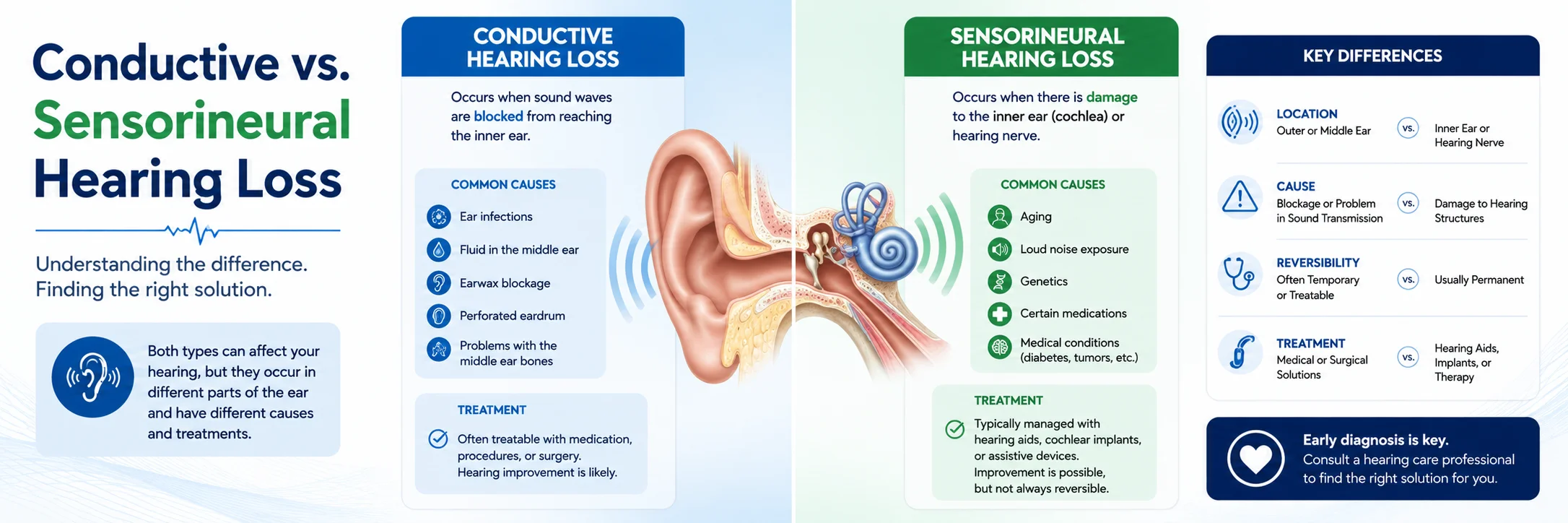
Conductive hearing loss occurs when sound cannot travel efficiently through the outer or middle ear to reach the inner ear. Think of it as a mechanical blockage or breakdown somewhere along the sound pathway. The inner ear itself is typically healthy — the problem lies in how sound gets conducted to it.
Common causes of conductive hearing loss include:
Earwax buildup (cerumen impaction) is one of the most frequent culprits. When wax accumulates and hardens in the ear canal, it physically blocks sound waves from passing through. Middle ear infections (otitis media) cause fluid to accumulate behind the eardrum, dampening vibrations. A perforated eardrum — caused by injury, infection, or sudden pressure changes — can significantly reduce the ear’s ability to transmit sound. Otosclerosis, an abnormal bone growth in the middle ear, can restrict the movement of the tiny bones (ossicles) responsible for conducting sound. Structural issues such as a collapsed ear canal or congenital malformations can also interfere with sound conduction.
People with conductive hearing loss often describe sounds as muffled or distant. They may find it easier to hear in quieter environments and may notice that their own voice sounds unusually loud to themselves.
The good news is that conductive hearing loss is frequently treatable. Medical interventions such as earwax removal, antibiotics for infections, surgery to repair the eardrum, or surgical correction of ossicle problems can often restore hearing partially or fully. When medical treatment isn’t sufficient, hearing aids can be highly effective because the inner ear remains functional and simply needs amplified sound to work with.
What Is Sensorineural Hearing Loss?
Sensorineural hearing loss (SNHL) is the most common type of permanent hearing loss. It results from damage to the hair cells of the inner ear (cochlea) or to the auditory nerve that carries signals to the brain. Unlike conductive hearing loss, sensorineural loss usually cannot be reversed through medication or surgery.
The most common causes include:
Age-related hearing loss, known as presbycusis, is a natural part of aging. Hair cells in the cochlea deteriorate gradually over decades, making it harder to hear high-pitched sounds first, then progressively lower ones. Noise-induced hearing loss (NIHL) is caused by prolonged or sudden exposure to loud sounds — machinery, concerts, headphones at high volume, or a single explosive blast. The hair cells in the cochlea are extremely delicate and do not regenerate once damaged. Certain medications, known as ototoxic drugs, can damage inner ear structures as a side effect. These include some chemotherapy agents, certain antibiotics, and high doses of aspirin or anti-inflammatory drugs. Viral infections such as mumps, measles, and meningitis can permanently damage the cochlea or auditory nerve. Genetic factors and sudden sensorineural hearing loss (SSHL) — a rapid loss that occurs over 72 hours or less — round out the major causes.
Symptoms of sensorineural hearing loss often include difficulty understanding speech, especially in noisy settings, trouble hearing high-frequency sounds like birdsong or children’s voices, tinnitus (ringing or buzzing in the ears), and a sense that people are mumbling even when they are speaking clearly.
Mixed Hearing Loss: When Both Types Occur Together
Some individuals experience mixed hearing loss, meaning they have elements of both conductive and sensorineural damage. For example, someone with age-related inner ear damage may also develop an ear infection that further compounds the problem. Treatment in these cases typically addresses the conductive component first, then manages the sensorineural element with hearing aids or other devices.
How Is Hearing Loss Diagnosed?
A proper diagnosis requires a hearing evaluation by an audiologist or ENT (ear, nose, and throat) specialist. The standard assessment is a pure-tone audiogram, which tests your ability to hear tones at different pitches and volumes. The results are plotted on a chart that visually shows the type, degree, and pattern of your hearing loss. Additional tests such as tympanometry (which measures eardrum movement) help determine whether a conductive component is present.
Early diagnosis matters enormously. Research consistently shows that untreated hearing loss is linked to social isolation, cognitive decline, depression, and reduced quality of life. The sooner hearing loss is identified and managed, the better the outcomes.
Treatment and Management Options
For conductive hearing loss, treatment is often curative. Medical procedures can remove blockages, repair damaged structures, and restore the normal sound pathway. Bone-anchored hearing aids (BAHA) are also a highly effective option for those with chronic conductive issues who are not surgical candidates.
For sensorineural hearing loss, hearing aids remain the gold standard of management. Modern digital hearing aids are sophisticated devices that can be programmed precisely to your audiogram, filtering background noise, amplifying specific frequencies, and connecting wirelessly to smartphones and televisions. For severe to profound sensorineural loss, cochlear implants may be recommended — these devices bypass damaged hair cells entirely and directly stimulate the auditory nerve.
Protecting Your Hearing Before Loss Occurs
Prevention is always more effective than treatment. Here are the most important steps you can take to protect your hearing:
Limit exposure to loud noise and always use earplugs or noise-canceling earmuffs in industrial, construction, or high-volume entertainment environments. Follow the 60/60 rule when using headphones — no more than 60% volume for no longer than 60 minutes at a time. Get regular hearing checkups, especially after age 50 or if you work in a noisy profession. Address ear infections and earwax problems promptly rather than letting them persist. Discuss ototoxic medication risks with your doctor if you are prescribed treatments known to affect hearing.
When to See a Professional
You should seek a hearing evaluation if you frequently ask people to repeat themselves, struggle to follow conversations in noisy places, need to raise the television volume higher than others prefer, notice ringing or buzzing in your ears, or experience a sudden change in your hearing. Any sudden hearing loss should be treated as a medical emergency and evaluated within 24 to 48 hours, as prompt steroid treatment can sometimes restore hearing.
Final Thoughts
Conductive and sensorineural hearing loss are two distinct conditions with very different underlying mechanisms, but both have a significant impact on daily life. Whether your hearing loss is temporary and treatable or permanent and manageable, the most important step is getting informed and taking action early. At Earmart, we’re committed to helping you understand your hearing health and find the right solutions — from professional-grade hearing aids to expert advice — so you never have to face hearing loss alone.


Leave a Comment
Your email address will not be published. Required fields are marked *